


👋🏽 Hi, I'm Saf! I teach CSEC French at Arc School: live classes each week, lesson resources, exam practice and personalised coaching for your final exams. Or maybe you're not studying for an exam at all and just want to learn French — you're welcome here too! ☺️ In this lesson, pay attention to which tense each part of the letter uses, and why. Then write your own letter about a job you can describe in your own French. Just don't copy my sentences into your exam answer. Your letter should sound like you.

Bonjour mes amis 👋🏽
Today we're writing a complete CSEC letter together: a letter to your cousin about the summer job you've just got. And we're going to use it to practise something you need to get comfortable doing in French: moving between tenses. In this letter, you're asked what the job is like now, what happened on your first day and what you're going to do with your pay. That's three different time frames — present, past and future — in about 150 words.
Today you'll write the whole letter, one point at a time, with each part in the tense it requires.
By the end of this lesson you will be able to:
write a French letter about a job that answers all four points, with the date, the opening and the ending in French;
say what your job involves, your hours and your pay;
say what you like and what you don't like about the job, and why;
tell the story of your first day, with the right past tense for what happened and for how things were;
say what you're going to do with your pay, in a tense that points to the future;
keep the whole letter between 130 and 150 words.
In the full lesson you'll hear me read a complete letter. Then you'll plan a new letter out loud and write it on your own.
If you are reading the free preview, subscribe to Arc to unlock the complete lesson. If you are already one of my students, keep going.
Grab a pen. Here's the task. ✍🏽
The task
This is a letter task from a past exam. Read it slowly, twice.
Use the following outline as a guide to write a letter in FRENCH, of NO MORE THAN 130–150 words.
You have just completed your exams and got a summer job. Write a letter to your cousin in France. Be sure to include
(i) details of the job (what it entails, salary, hours)
(ii) what you like and do not like about the job
(iii) a description of your first day on the job
(iv) what you will do with your salary.
(Do NOT write your real name and address, but include the date in FRENCH and use the appropriate beginning and ending.)
Before you write a word, look at what the task asks for.
You're writing to your cousin, so you use the tu forms all the way through: tu, te, ta, ton, tes.
Point (i) asks for three things: what you do, how much you earn and when you work. Leave one out and point (i) isn't finished.
Point (ii) asks for what you like and what you don't like. You need both.
Points (iii) and (iv) are where the tense changes. Your first day is over, so it goes in the past. Your salary plans haven't happened yet, so they point to the future.
A complete letter 🎧
Here's a letter I wrote for this task. I wrote it as a boy called Jordan, so the endings are masculine. If you're a girl, some words change, and I'll show you which ones.
Listen once without reading. Then listen again and read along.
Arima, le 18 juillet 2027
Chère Camille,
Comment vas-tu ? Mes examens sont finis et j'ai trouvé un petit boulot dans un camp de vacances pour enfants. Je surveille les petits et j'organise des jeux. Je travaille du lundi au vendredi, de huit heures à quinze heures, et je gagne vingt-cinq dollars de l'heure.
J'adore mon travail parce que les enfants sont drôles. Par contre, je n'aime pas me lever à six heures, et le bruit me fatigue.
Le premier jour, je suis arrivé à sept heures. J'étais très nerveux et il faisait chaud. La directrice m'a présenté aux autres moniteurs. À midi, un petit garçon est tombé. J'ai eu peur, mais il n'a pas pleuré.
Avec mon salaire, je vais acheter un ordinateur pour mes études. Je vais aussi mettre de l'argent de côté pour venir te voir en France l'été prochain.
Écris-moi vite !
Grosses bises,
Jordan
The whole letter is 147 words, counting the date, the opening and the ending.
If you need the English, here it is:
Arima, 18 July 2027. Dear Camille, How are you? My exams are over and I've found a summer job at a holiday camp for children. I look after the little ones and I organise games. I work Monday to Friday, from eight o'clock to three o'clock, and I earn twenty-five dollars an hour. I love my job because the children are funny. On the other hand, I don't like getting up at six o'clock, and the noise makes me tired. On the first day, I arrived at seven o'clock. I was very nervous and it was hot. The manager introduced me to the other camp leaders. At midday, a little boy fell. I got scared, but he didn't cry. With my salary, I'm going to buy a computer for my studies. I'm also going to put some money aside to come and see you in France next summer. Write back soon! Lots of love, Jordan
How the letter answers each point
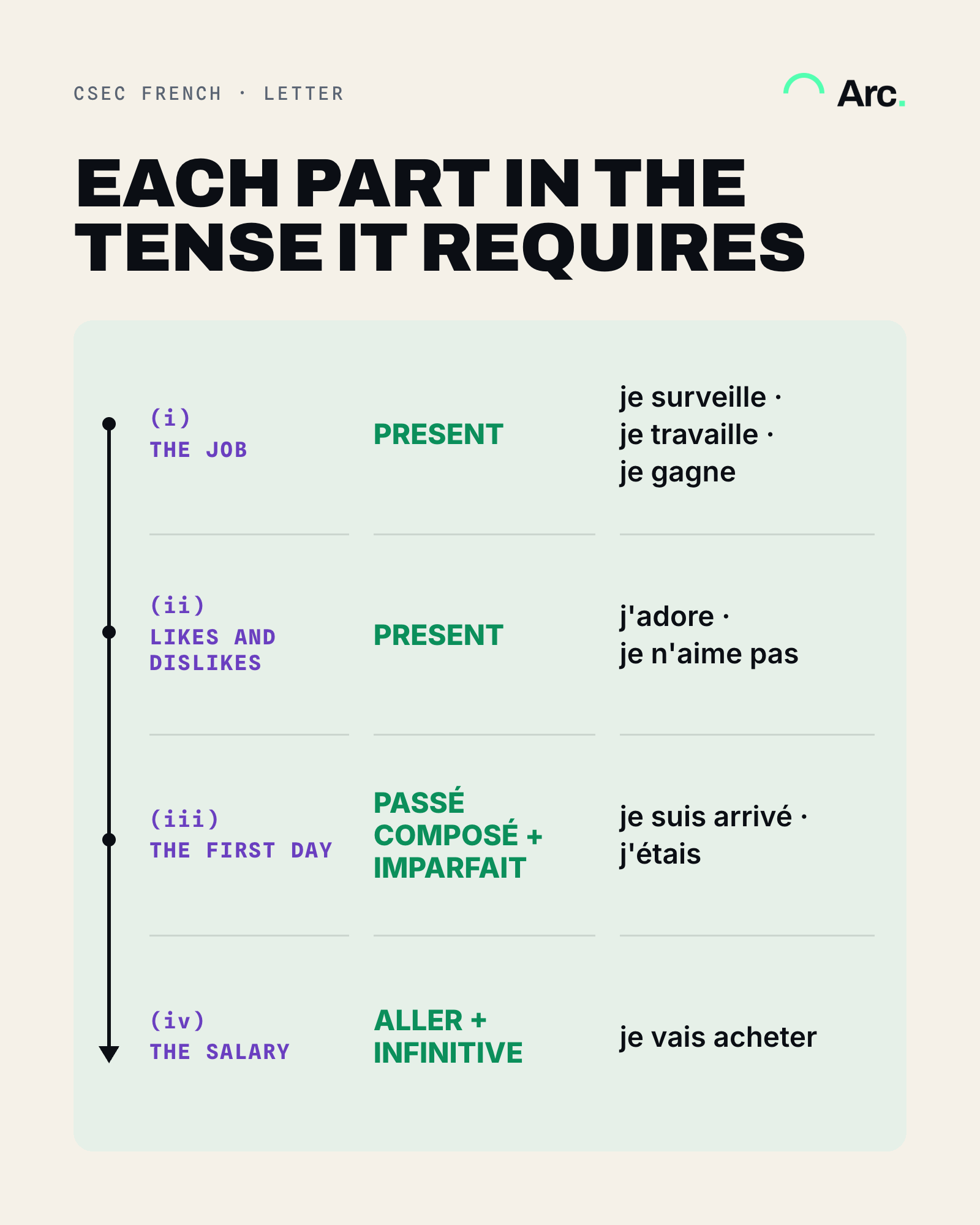
I gave each point its own paragraph. You don't have to, but it makes the four points easy to see, and you can check each one before you finish.
Look at the verbs in each paragraph.
Point (i), the job: je surveille, j'organise, je travaille, je gagne. All present, because this is what Jordan does every day.
Point (ii), likes and dislikes: j'adore and je n'aime pas. Still present, because he still feels this way.
Point (iii), the first day: je suis arrivé, m'a présenté, est tombé, j'ai eu peur for what happened. J'étais and il faisait for how things were.
Point (iv), the salary: je vais acheter, je vais mettre. Aller in the present, then the verb you'd use.
The first line, j'ai trouvé un petit boulot, is in the past too. Jordan found the job before he wrote the letter, but he's still doing it, so everything else about the job stays in the present.
A quick layout check
Three things to get right before the first point.
The date. Write the town, a comma, then le, the number and the month. The month has no capital letter: Arima, le 18 juillet 2027. For the first of the month, write le 1er juillet.
The opening. Cher for a boy, Chère for a girl: Cher Lucas, Chère Camille. Check this one. It's easy to forget the second e.
The ending. One short line, then a goodbye, then a first name. The task says not to use your real name, so sign with any first name. For a cousin, Grosses bises or Je t'embrasse works. For a pen pal, Amitiés.
Point (i): the job, in the present
Jordan's job is still going on, so he describes it in the present. You need three details: what you do, your hours and your pay.
These words help with any job. They're a start, not a full list:
un petit boulot a summer or part-time job · le salaire the pay · les heures the hours · le patron / la patronne the boss · les clients the customers
For the hours and the pay, these patterns do the work:
Je travaille du lundi au vendredi.
Je travaille de huit heures à quinze heures.
Je gagne vingt-cinq dollars de l'heure / par semaine.
Here's a second job, at a hotel:
Je travaille dans un hôtel à Tobago. Je réponds au téléphone et j'accueille les clients. Je travaille de sept heures à quinze heures et je gagne quatre cents dollars par semaine.
And a third, at a garage:
Je travaille chez mon oncle qui est mécanicien. Je lave les voitures et je range les outils. Je commence à huit heures, je finis à midi, et il me donne deux cents dollars par semaine.
Each one says what the person does, when they work and what they earn. That's point (i) finished.
Point (ii): what you like and what you don't
You need both halves. J'aime or j'adore for the part you like, then je n'aime pas or je déteste for the part you don't. Give a reason with parce que where you can.
After j'aime, j'adore, je n'aime pas and je déteste, the next verb stays in the infinitive — the basic, unconjugated form of the verb you'd find in the dictionary:
Je n'aime pas me lever à six heures.
J'adore jouer avec les enfants.
The ne … pas goes around aime, and the verb after it stays as it is: je n'aime pas travailler.
Here's how the hotel worker might say it:
Ce que j'aime, c'est parler avec les touristes, parce que je pratique mon français. Mais je n'aime pas travailler le dimanche.
And the garage worker:
J'aime bien apprendre à réparer les moteurs. Par contre, je déteste avoir les mains sales.
Par contre (on the other hand) and mais (but) move you from the good part to the bad part.
Point (iii): your first day, in the past
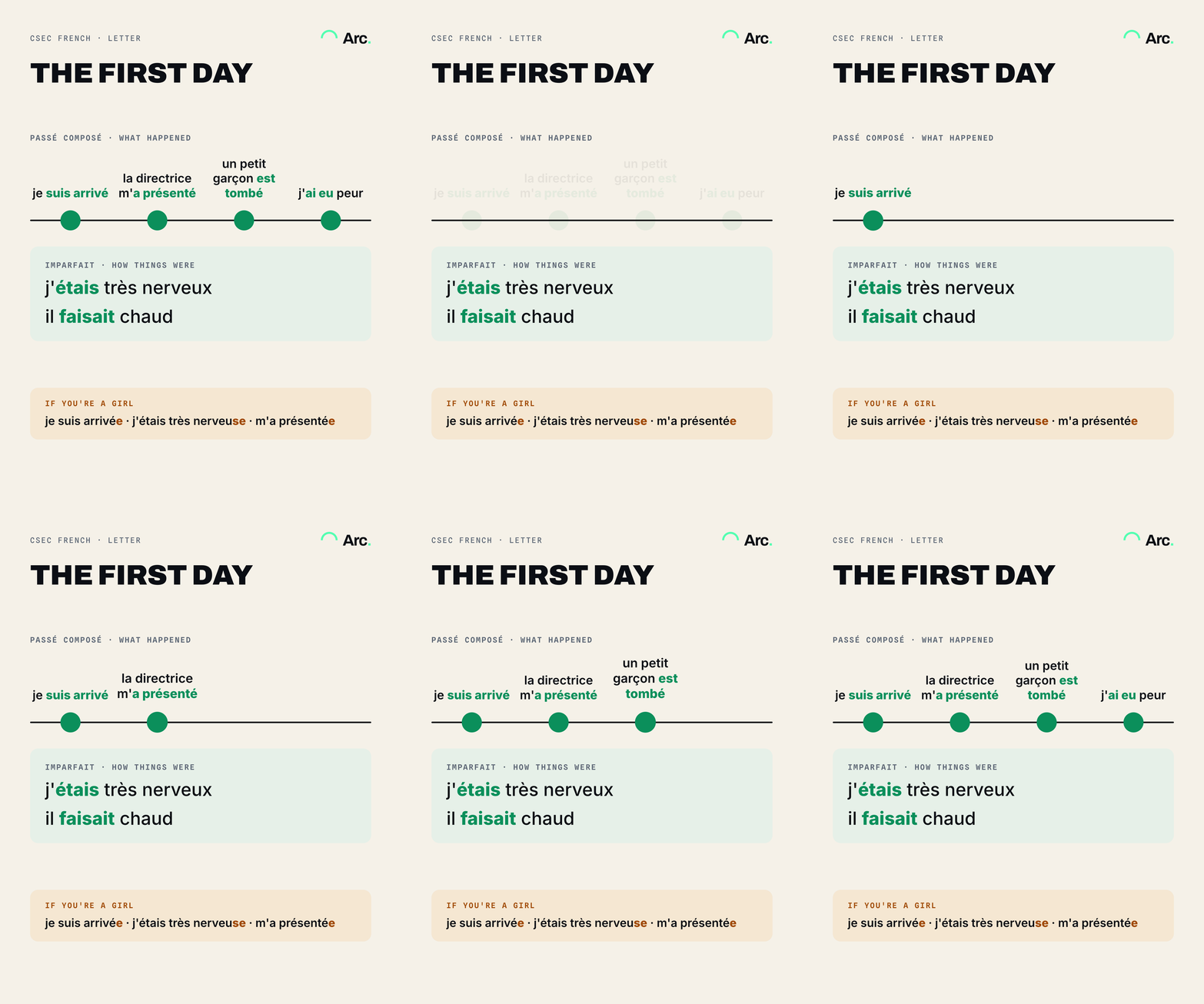
This is the one point that needs two past tenses. Watch the card. The things that happened drop onto the line one after the other. The things that were true the whole time sit underneath.
The passé composé is for what happened: actions completed in the past that move the story forward.
je suis arrivé · la directrice m'a présenté · un petit garçon est tombé · j'ai eu peur · il n'a pas pleuré
The imparfait is used to describe how things were while those events took place: the weather, how you felt all morning, what the place was like. In other words, it sets the scene rather than moving the story forward.
j'étais très nerveux · il faisait chaud · il y avait beaucoup d'enfants
A feeling can go either way. J'étais très nerveux is how Jordan felt all morning, so it's imparfait. J'ai eu peur is what he felt at the moment the boy fell, so it's passé composé.
Most verbs use avoir in the passé composé: j'ai eu, il a pleuré. A few use être, and you'll need some of them to describe what happened on your first day at the job: arriver, partir, aller, venir, tomber, rester, entrer, sortir. So do verbs with me, te or se: je me suis levé.
With être, the ending matches the person. If you're a girl, you write je suis arrivée, with an extra e. The same goes for nerveux, which becomes nerveuse. And in la directrice m'a présentée, if the m' refers to a girl, you add the e there too. There's more on direct and indirect object pronouns in a later lesson.
Here's a second first day, at the hotel:
Le premier jour, il pleuvait et j'étais en retard. Quand je suis arrivée, la patronne m'a montré la réception.
And a third, at the garage:
Le premier jour, mon oncle m'a expliqué le travail. L'atelier était petit et il y avait beaucoup de bruit. Vers dix heures, j'ai cassé une bouteille d'huile.
Find the imparfait in each one before you move on. (pleuvait, étais; était, avait.)
Point (iv): your plans, with aller + infinitive
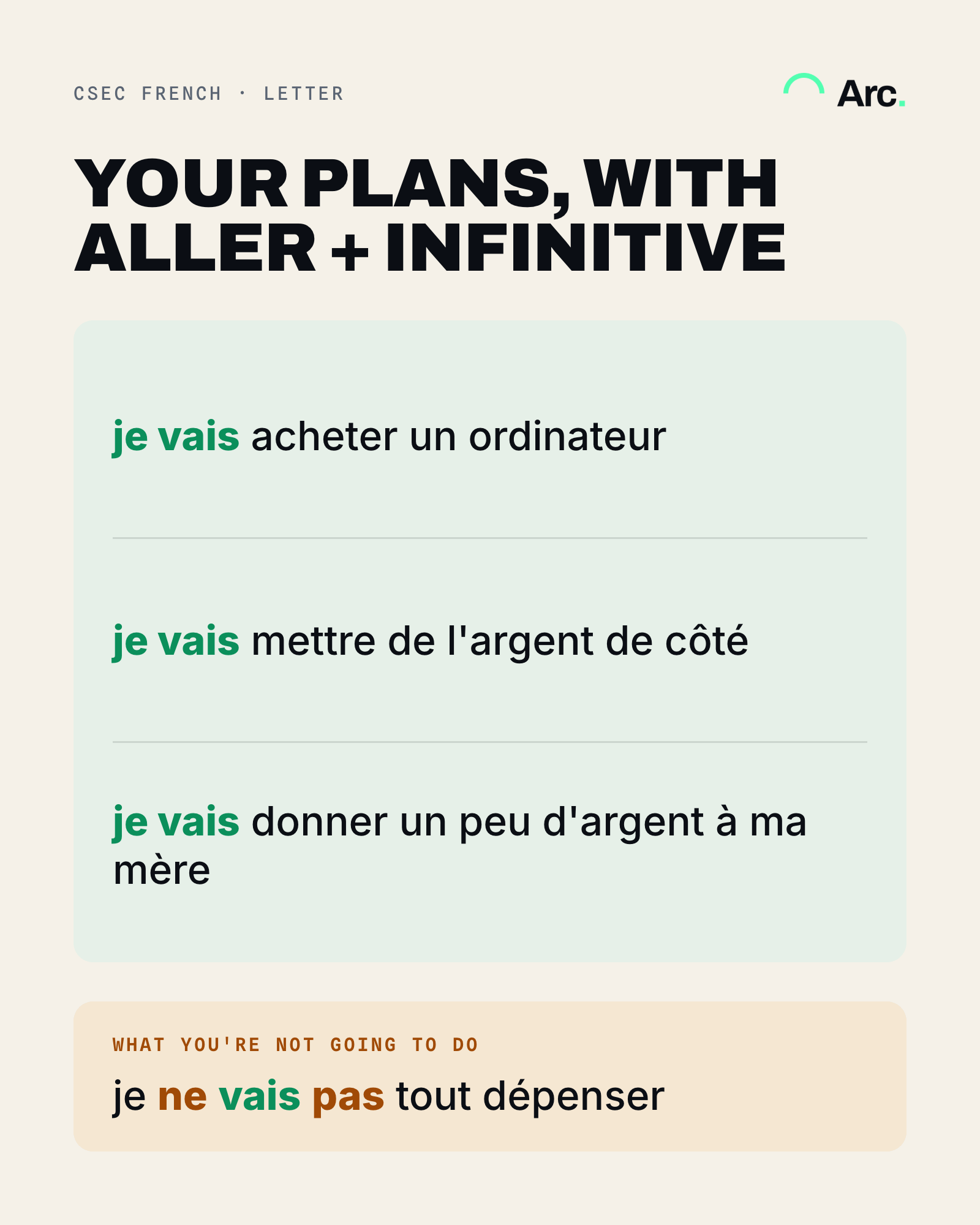
Your plans haven't happened yet. The simplest way to say what you're going to do is the present of aller, then the verb in the infinitive:
je vais acheter · je vais mettre de l'argent de côté · je vais donner un peu d'argent à ma mère
To say what you're not going to do, the ne … pas goes around vais:
Je ne vais pas tout dépenser.
You can also use the future tense (j'achèterai, je donnerai). If you do, check the accent on achèterai. I'd use aller + infinitive in this letter. It's easier to get right when you're writing quickly.
Give this point two or three sentences, with a reason. Jordan says what he'll buy, then what else he'll do with the money, and why.
Here's a second way to answer point (iv):
Avec mon salaire, je vais aider mes parents à payer mes livres. Je ne vais pas tout dépenser, parce que je veux faire des économies.
And a third:
Je vais acheter un téléphone, et je vais offrir un cadeau à ma grand-mère pour son anniversaire.
Count your words
I count every word I write, including the date, the opening and the ending, and I keep the total between 130 and 150. Count j'ai or l'heure as one word, the way it's written.
Plan your space before you start. Jordan's four points take 46, 24, 38 and 27 words. Point (i) is the longest because it has three details in it. Point (iv) still gets two full sentences.
If you go over 150, cut a detail from point (i) or (iii). Don't cut a whole point.
Practise one step at a time ✍🏽
Write your answers first. The answers are at the end of the lesson.
Listen and sort. 🎧 Play the recording. You'll hear six sentences. After each one, pause and say which part of the letter it belongs to: point (i), the job now; point (iii), the first day; or point (iv), your plans.
Put the verb in the right tense.
Je (travailler) _ dans un hôtel tous les jours sauf le dimanche.
Le premier jour, je (arriver) _ en retard.
Ce matin-là, il (pleuvoir) _ et il y (avoir) _ beaucoup de clients.
Le patron m'(expliquer) _ mon travail.
Avec mon salaire, je (acheter) _ un téléphone.
Je (gagner) _ trois cents dollars par semaine.
Ce jour-là, à midi, nous (manger) _ ensemble.
L'année prochaine, ma sœur (chercher) _ un petit boulot aussi.
Grow the last point. Point (iv) asks what you're going to do with your pay. Look at this answer:
Avec mon salaire, j'ai acheté des vêtements.
It has two problems. Find them, then rewrite point (iv) in two or three sentences.
Three mistakes to fix
1. The last point gets one sentence.
You write a lot for points (i) and (ii), then run out of words or ideas, and point (iv) gets one line. Point (iv) is where you can show the future tense, so give it room.
The fix: plan your words before you start, and keep about 25 to 30 words for point (iv).
✗ Avec mon salaire, je vais acheter un ordinateur.
✓ Avec mon salaire, je vais acheter un ordinateur pour mes études. Je vais aussi mettre de l'argent de côté pour venir te voir en France l'été prochain.
2. The passé composé for something that happened once in the past.
In English, "fell" and "was falling" both look like the past, so it's easy to grab the wrong French tense. If it happened once, as one step in the story, it's passé composé. Check the auxiliary verb too: tomber and arriver take être.
✗ À midi, un petit garçon *tombait.
✓ À midi, un petit garçon est tombé.
If you're describing background information on how things were at the time that something else happened, you use the imparfait.
3. Plans written in the past.
When you've spent the whole of point (iii) in the past, it's easy to stay there. But your salary hasn't been spent yet.
✗ Avec mon salaire, *j'ai acheté un vélo.
✓ Avec mon salaire, je vais acheter un vélo.
Your turn: a new letter
This is a new task I wrote in the same format. This time the job is in a shop.
Use the following outline as a guide to write a letter in FRENCH, of NO MORE THAN 130–150 words.
You have just finished your exams and got a part-time job in a shop. Write a letter to your pen pal in Guadeloupe. Be sure to include
(i) details of the job (the kind of shop, what you do, your hours and pay)
(ii) what you like and do not like about the job
(iii) a problem with a customer last Saturday and how you dealt with it
(iv) whether you will keep the job in September, and why.
(Do NOT write your real name and address, but include the date in FRENCH and use the appropriate beginning and ending.)
Look at what changed. Point (iii) is still a story in the past, but now it's about a customer. Point (iv) asks about September, and it asks why, so it needs a reason.
Say it first. 🎧 Play the recording. I'll ask you five questions about your shop job. Pause after each one and answer out loud in French. Then write.
Now write the letter. Don't look back at Jordan's letter while you write. When you've finished, check it:
The date, the opening and the ending are in French.
Point (i) has the kind of shop, what you do, your hours and your pay.
Point (ii) has something you like and something you don't.
Point (iii) tells what happened in the passé composé and how things were in the imparfait.
Point (iv) says what you're going to do, and why.
You used tu with your pen pal all the way through.
The whole letter is between 130 and 150 words.
Then read your letter aloud once. You may catch an ending you missed.
Answers
Listen and sort.
Je vais mettre de l'argent de côté. (point iv: your plans)
Je suis arrivée à huit heures. (point iii: the first day)
Je travaille à la caisse. (point i: the job now)
Il y avait beaucoup de clients. (point iii: the first day)
Je gagne quatre cents dollars par semaine. (point i: the job now)
Je vais acheter un vélo. (point iv: your plans)
Put the verb in the right tense.
travaille (something you do every week, so present)
suis arrivé (a boy) or suis arrivée (a girl) (it happened once, and arriver takes être)
pleuvait, avait (how things were that morning, so imparfait)
a expliqué (one thing the boss did)
vais acheter (a plan). achèterai is also right.
gagne (your pay now)
avons mangé (one thing you did that day)
va chercher (a plan). cherchera is also right.
Grow the last point. There are two problems. J'ai acheté is in the past, but the salary plans haven't happened yet, and the whole point is one sentence. Here's one way to fix it:
Avec mon salaire, je vais acheter des vêtements pour l'école. Je vais aussi donner un peu d'argent à ma mère, parce qu'elle m'aide beaucoup.
Your version can be different. Check that it uses aller + infinitive, has at least two sentences and gives a reason.
Your new letter. Here's one possible letter. I wrote it as a girl called Tamara. Yours will say different things, and that's how it should be. Check your letter against the list above.
Chaguanas, le 2 août 2027
Chère Inès,
Merci pour ta lettre. J'ai un petit boulot dans un magasin de chaussures. J'aide les clients à trouver leur taille et je travaille à la caisse. Je travaille le vendredi et le samedi, de neuf heures à dix-huit heures, et je gagne cinq cents dollars par semaine.
J'aime parler avec les clients et mes collègues sont sympas. Par contre, je n'aime pas rester debout toute la journée.
Samedi dernier, il y avait beaucoup de monde. Une dame voulait rapporter des sandales, mais elle n'avait pas son ticket de caisse. Elle s'est fâchée et j'étais stressée. J'ai appelé la patronne, et la dame a choisi une autre paire.
En septembre, je vais garder ce travail, mais seulement le samedi, parce que je vais retourner à l'école. J'aurai besoin d'argent pour mes livres. Et toi, tu travailles ?
Amitiés,
Tamara
That's 144 words. Look at the tenses in point (iii). Il y avait, voulait, n'avait pas and j'étais are how things were. S'est fâchée, ai appelé and a choisi are what happened. Elle s'est fâchée uses être because of the se, and it ends in -e because the customer is a woman.
If a tense was wrong in your letter, go back to the point it belongs to and read that part of the lesson again. Then write that paragraph a second time.
Bring your letter to your live class. If you're not in a class, post it in the chat. I'll check the tense in each paragraph first. 👀
À très bientôt !
— Saf 💚
